Defending Disability Rights in Alberta - Click here to read our legal brief the ADAP & CDB Clawback

A platform for disability advocacy and continuity of care needs for individuals with complex needs.
Grounded in lived experience and rooted in Christ, bringing forward the reality of the caregiver cliff.

Mason is 23 years old and lives at home with his family. He is impacted by autism, epilepsy, and developmental delays. Mason is nonverbal and communicates using Proloquo2Go, PECs, pointing, signs and by bringing items to others.
He has a good sense of humor if you can pick up on his nonverbal communication and his laugh is contagious. Mason thrives when his environment and days are structured (2:1 care), as he enjoys the outdoors, recreational activities, and being involved in the community.

Individuals who require ongoing, high-level support are living in environments that are not designed to meet their needs.
Care is being managed by families without consistent, structured support systems in place to carry it forward over time.
There is a clear gap between the level of care required and the environments that are available to support it. One that calls for truth and accountability before God.
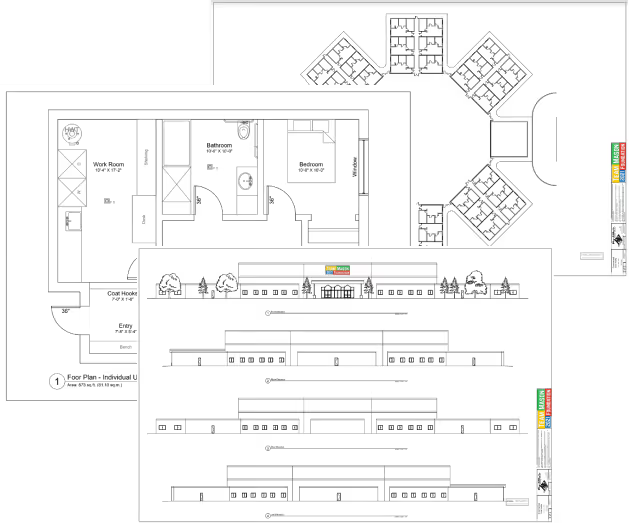
A proposed, system-informed housing model shaped by years of lived experience navigating complex care needs.

Tanner is 18 years old. His diagnosis of Autism and Epilepsy has created several challenges for him and his family to work through. He currently lives on an acreage with his siblings and parents where he spends most of his time. Tanner likes to go for rides either on the side-x-side, motorhome or in a vehicle...

Time just moves along...
This is my story...
My son Lukas is smart, happy, fun & loves to be engaged. This now young man gives me a love I know I have never had. I love being his mom and wish that I could be with him all of his life; everyday a piece of my heart breaks that “the plan” for when I am gone is not in place.
Teammason2021 Foundation gives me hope and joy for his future; Lukas will have the support, interaction and opportunity to grow and be happy, fun and engaged.
Understanding the caregiver cliff requires more than awareness — it requires clarity on how systems fail and what must exist to ensure continuity of care.
This platform documents lived system navigation and exposes structural gaps — culminating in the Mason Standard of Care™, a defined, enforceable framework for continuity of care.


